Published Articles
By Charlotte Noon
Times Educational Supplement Feature Article
"Why the need for speed?" by Charlotte and Martin Noon
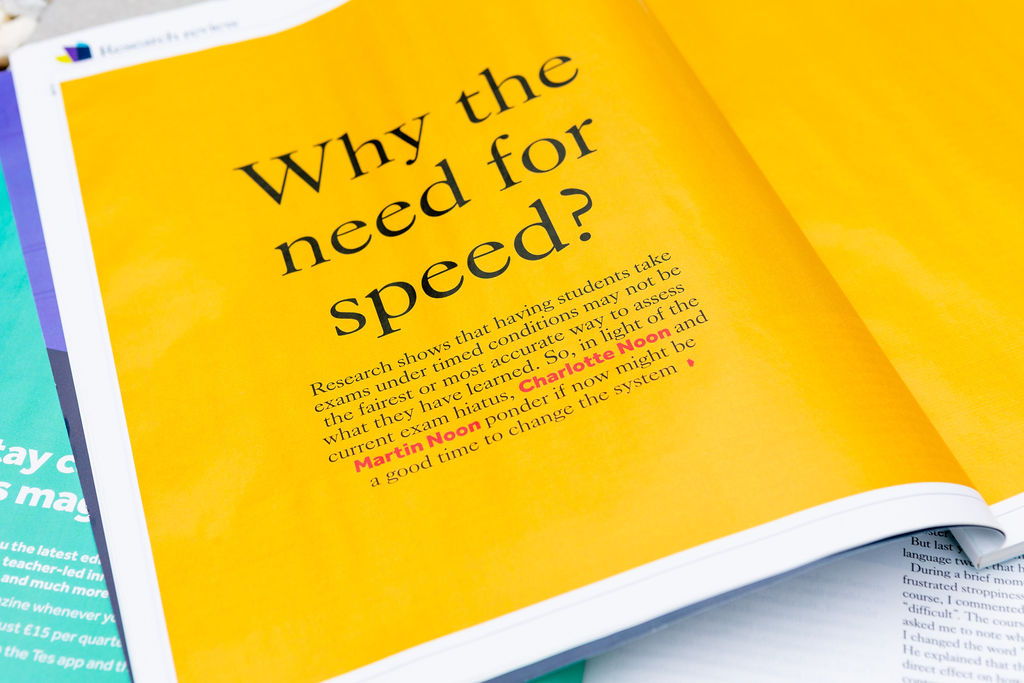

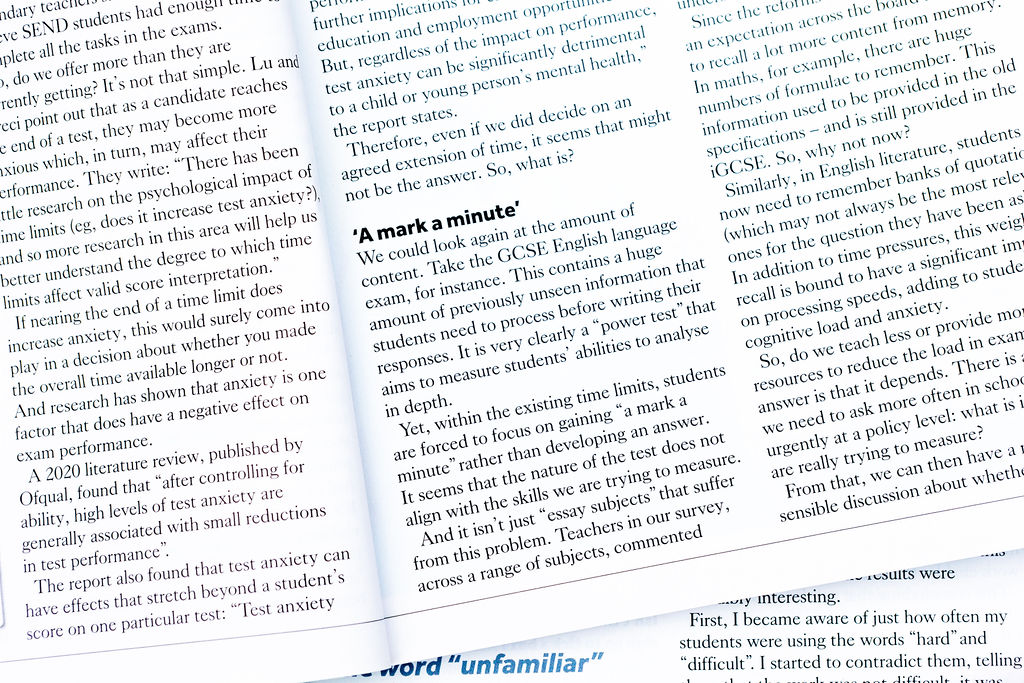
Following the exam hiatus caused by the Covid-19 pandemic, my husband Martin Noon and I were approached by the editor of TES to undertake a 4-page research article about whether students undertaking exams under timed conditions was a fair and accurate way to test them. We followed this up with an interview on the TES podcast.
We discovered that a whopping 81.4% of secondary teachers believed the exam system was in need of a change with many primary teachers calling for SATS to be "scrapped". Many teachers reported that they did not feel the time limits given enabled students to think deeply and produce their best work and that the exams really seemed to be testing the students' ability to recall information under pressure, rather than their understanding of the topic.
The conclusion to the article: Too many young people are being excluded from a future they are capable of partaking in, not on the basis of what they know (or don't know) but simply on the basis of how quickly they can demonstrate it.
Times Educational Supplement Growth Mindset Column
"I'm all for exploring familiar territory" by Charlotte Noon
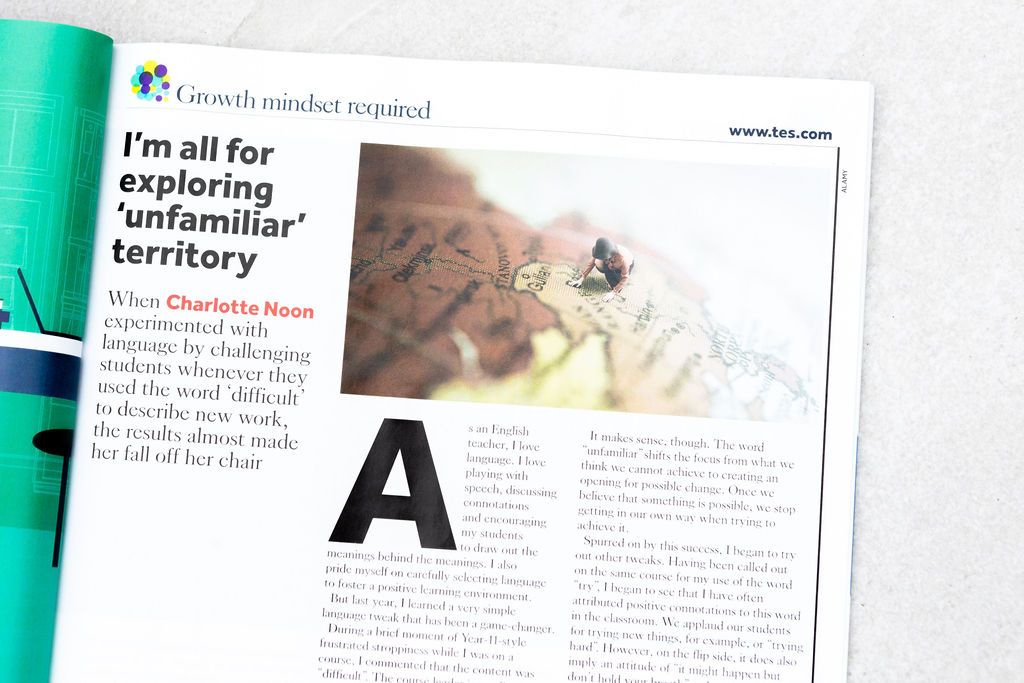
I was commissioned to write a piece based on my own experience of how minor language tweaks in the classroom have delivered big results in terms of growth mindset. Changing the word "difficult" to "unfamiliar", for example, can completely change a student's attitude to attempting a task and the word "try" speaks volumes in terms of the self-doubt a student may be feeling.
Opening of the article: As and English teacher, I love language. I love playing with speech, discussing connotations and encouraging my students to draw out the meanings behind the meanings. I also pride myself on carefully selecting language to foster a positive learning environment. But last year, I learnt a very simple language technique which has become a game-changer.
Article for Rapport Magazine
"Success is an inside job: why it's vital that teens set their own target grades"

A snippet from the article:
Target grades were not treated with the same level of reverence when I started my teaching career. Now, however, it is too often the case that in my first coaching session with a teen, they will introduce themselves as a number. “I am a 4 for English. I need to be a 6,” they sigh.
A low target grade creates a ceiling which the student often feels that they cannot move beyond. When I ask my students what grade they want, they are often embarrassed as they sheepishly admit to me that they would really like a 9, although they have only been predicted a 6, as though they somehow have ideas above their station. The first thing I do is help them to remove that ceiling.
A Neuro-Linguistic Programming (NLP) Modelling Project for Rapport Magazine
"How can you help your teenager be more confident?" by Charlotte Noon
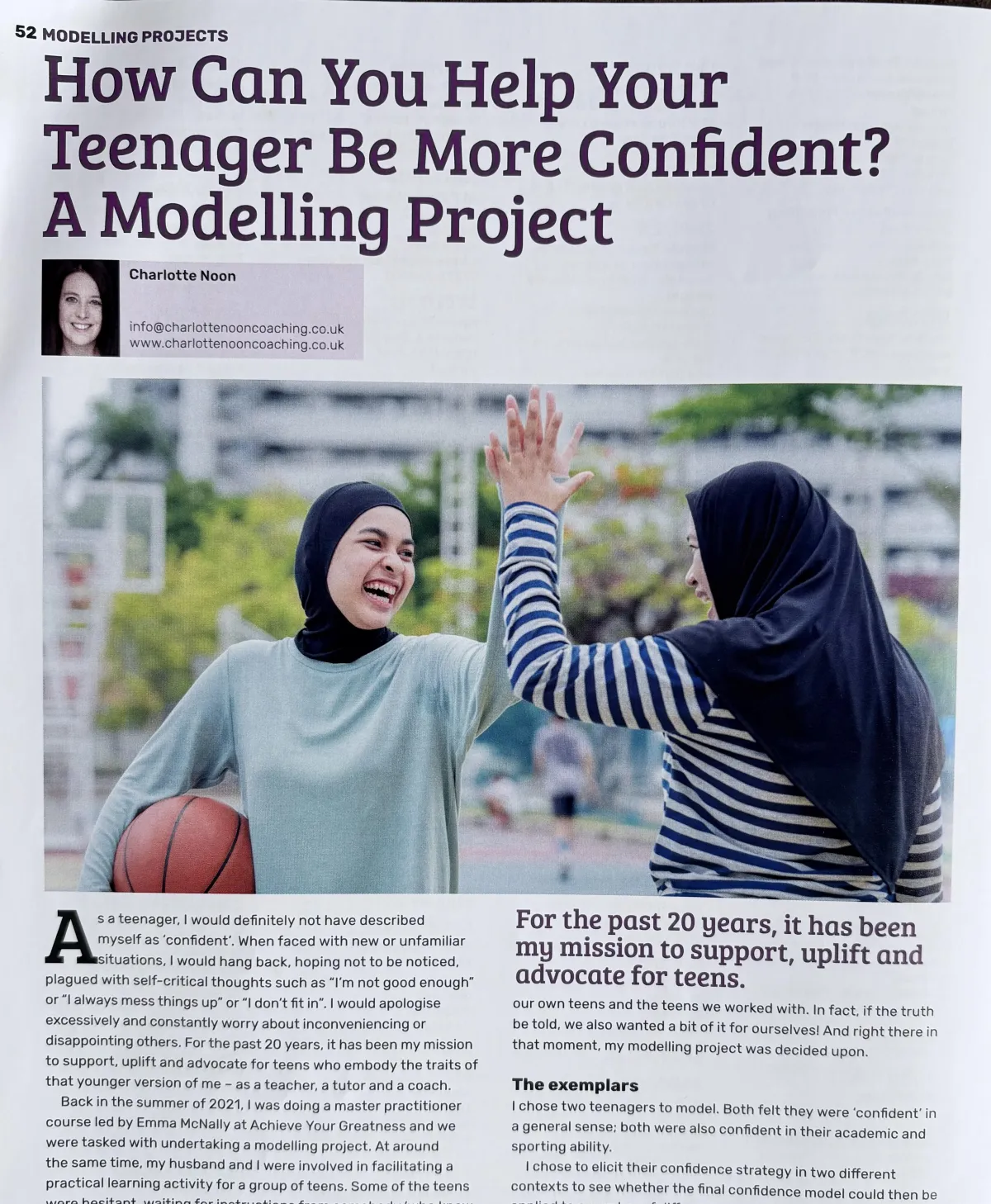
An introduction to the project:
As a teenager, I would definitely not have described myself as “confident”. When faced with new or unfamiliar situations, I would hang back, hoping not to be noticed, plagued with self-critical thoughts such as “I’m not good enough” or “I always mess things up” or “I don’t fit in”. I would apologise excessively and constantly worry about inconveniencing or disappointing others. For the past 20 years, it has been my mission to support, uplift and advocate for teens who embody the traits of that younger version of me – as a teacher, a tutor and a coach.
Back in the summer of 2021, I was doing a Master Practitioner course led by Emma McNally at Achieve Your Greatness and we were tasked with undertaking a modelling project. At around the same time, my husband and I were involved in facilitating a practical learning activity for a group of teens. Some of the teens were hesitant, waiting for instructions from somebody “who knew the answers” (as we would have done at their age). However, there was a small minority who bounded head-first into the situation - full of enthusiasm and excitement - automatically voicing their opinions and proposing ideas, whilst remaining sensitive to others’ needs. They seemed to have an unwavering faith in their skills, knowledge and competence and when they encountered challenges, they simply changed their approach. These teenagers literally oozed confidence.
We were in awe. Imagine if that magic formula could be bottled and shared with others. We wanted to be able to give that gift to our own teens and the teens we worked with. In fact, if the truth be told, we also wanted a bit of it for ourselves! And right there in that moment, my modelling project was decided upon.
Charlotte Noon writes about how education systems shape confidence, behaviour, and who gets seen as capable — and why that matters beyond the classroom.

07736160225